





If your brand shows a clear misalignment declining performance, an outdated image, shifting customer behavior, or intensifying competition? then repositioning is no longer optional. When your brand no longer reflects who you are or what customers need, brand repositioning becomes a survival strategy to stay relevant and competitive.
1/ Repositioning is not optional it’s a survival instinct
There’s one question every business should ask itself regularly: “Do customers today still perceive us the way we intend them to?”
If the answer seems uncertain, your brand is heading in the wrong direction.
In today’s landscape, brand positioning is no longer about a catchy slogan or a nice color palette It defines:
– How customers remember you
– Why they choose you over competitors
– And most importantly, why they come back
Three things are changing faster than ever:
– Customer insight (from “cheap” → “value” → “experience”)
– Buying behavior (offline → online → omnichannel)
– Competitive standards (product → service → ecosystem)
If your brand doesn’t evolve → customers won’t wait. Repositioning = upgrading, not restarting:
A common misconception:
“Repositioning means starting over”. Not true.
Effective repositioning:
– Preserves your core DNA
– Reinvents how you tell your story
– Optimizes how you connect with customers
Repositioning sometimes, small shifts in:
– Messaging
– Visuals
– Experience
Can completely reshape perception.
Examples:
Apple: From a computer manufacturer to a lifestyle ecosystem brand.
Starbucks: Not just coffee but a “third place” experience.
VinFast: From a local automaker to a global EV player in record time.
2/ When does a brand NEED repositioning?
Not every brand should reposition but ignoring the right moment is costly.
2.1. Your customers have changed but you haven’t
Signals:
– Content gets reach but no conversion
– Younger audiences don’t relate
– Your message no longer resonates
Example: Fitness: “lose weight fast” become “wellness & mental health”
F&B: “filling meals” become “healthy lifestyle”
2.2. You’re becoming indistinguishable
If customers:
– Can’t tell you apart from competitors
– Or recall competitors before you
Your positioning is weak.
2.3. Your brand feels inconsistent
Symptoms:
– Logo says one thing, social says another
– Premium messaging, but average experience
– Youthful tone, but outdated visuals
This is brand inconsistency
2.4. Performance doesn’t match potential
Not just declining revenue more subtle signs include:
– Flat growth in a growing market
– High traffic, low conversion
Your positioning isn’t hitting the right pain point.
2.5. Your business is entering a new phase
Key transition points:
– From Startup to Scale-up
– From Local to Regional / Global
– From Product to Brand
– From Retail to Ecosystem
Example: Netflix from DVD rental → streaming → content production → entertainment ecosystem.
3/ A strategic framework for repositioning (without breaking your brand)
3.1. Start with truth, not assumptions
You need 3 layers of insight:
– Customer truth (what they actually want)
– Market gap (what competitors don’t offer)
– Internal strength (what you do best)
=>The intersection become your new positioning
3.2. Rebuild your Brand Core
Not just visuals but:
– Purpose (why you exist)
– Value proposition (what you deliver)
– Personality (how you behave)
– Positioning statement (your place in the mind)
3.3. Rewrite your brand story
A strong brand answers:
– Who is this for?
– What makes you different?
– Why should I trust you?
If it takes more than 10 seconds, your brand signal isn’t clear enough.
3.4. Redesign experience not just identity
Big mistake:
Rebranding = changing logo
Reality:
– Website
– Physical space
– Staff behavior
– Packaging
– Customer journey
Brand language across all platforms needs to be ” the same language”

3.5. Launch it like a campaign, not a quiet update
Effective repositioning needs:
– A strong big idea
– A clear launch strategy
– Integrated communication
Example: Dove with “Real Beauty” → reshaped global beauty standards.
3.6. Measure what truly matters
Beyond revenue, track:
– Brand perception
– Recall
– Customer sentiment
– Customer lifetime value (CLV)
4/ The real benefits of repositioning
4.1. You can charge more
Clear positioning → customers compare value, not price.
4.2. You attract the right customers
Repositioning
– Filters out mismatched audiences
– Increases customer quality
4.3. Marketing becomes easier
Clear positioning means:
– Easier content creation
– Better targeting
– Stronger messaging
4.4. Internal alignment improves
A strong brand helps:
– Teams stay focused
– Sales communicate confidently
– Hiring becomes easier
4.5. You build long-term competitive advantage
Products can be copied
Prices can be undercut
But positioning in the customer’s mind is hard to replicate
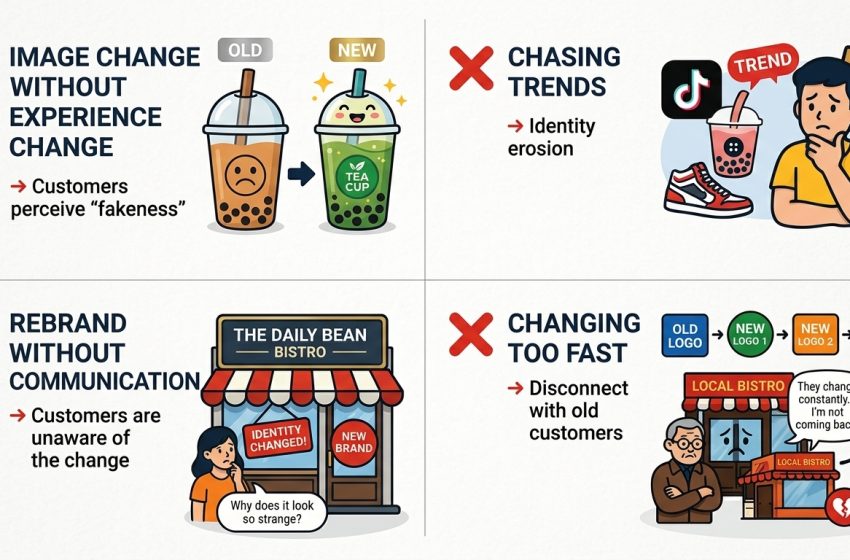
5/ Critical mistakes to avoid
Changing visuals without changing experience
→ feels inauthentic
Chasing trends
→ loses identity
Rebranding without communication
→ customers don’t notice
Moving too fast
→ alienates loyal customers

6/ Conclusion: Repositioning is a strategic pivot
Repositioning is not just a marketing task.
It operates at the intersection of: Business + Brand + Growth
Strong brands are not static. They are brands that:
– Know when to evolve
– Know what to change
– And evolve without losing their essence
Final question for your brand: If you were to rebuild your brand today, Would you do it the same way?
If the answer is “not really” → that’s your signal to start thinking about repositioning.